
_edited.jpg)
Anfield VR Stadium Tour
Tourism Software
Role:
Solo Developer
Assignment:
Final College Project
Programs:
Unity 5 & Blender
Interactive Media Design
This project was based on answering a question in game theory: How profitable would a virtual stadium tour be for sports clubs due to geo-accessibility or the pandemic?
The research carried out was put into a presentation, designed into a document, and thus, started the five-week process of creating the tour in Virtual Reality.
Initially, meant for mobile but due to the lack of resources, I was able to create it for VR Headsets with the desire to port to mobile at a later stage.
The idea was to make the entire tour from scratch, which required modeling the stadium and texturing, adding in the interactive areas, and reiterating any design. Due to the seamless use of interactions used in the Unity Game Engine for VR, I was able to produce a tour with enough interaction for all users in a short space of time.
No available build due to copyright and branding infringement
Stadium Tour VR Full Walkthrough
Below is a lengthy video of the VR tour demo and what players can expect from the experience of a VR Stadium Tour! After that, let's walk through the process from idea conception all the way to public release.
Idea Conception
One of the biggest issues in the world struck our planet in 2020, leading to a total shutdown of economic areas especially in the hospitality industry. On top of that, due to geopolitical issues, accessibility to different countries have become more difficult. So, what happens to major landmarks?
That's the problem that this project aims to answer
-
The task at hand was to put as much time and research into the presentation as possible, trying to answer as many small questions as possible to gather supporting evidence to answer the bigger question.
-
In this case: How marketable is a VR Stadium Tour in 2021?

-
The vision consisted of a few short key indicators:
-
The tour needed to be interactable
-
The stadium needed to be physically accurate
-
The information needed to be accessible and in more than just one form (ie. audio, controls, text etc.)
-
The content needed to be fully modular for consistent updates
-
-
The research did provide insightful information on how to appeal to the target market.
-
I landed on Liverpool Football Club, due to their rich history and wide international fan base making them a highly marketable brand for this project.
-
-
The short write-up below talks about the marketability of a stadium tour for the mobile device and why it's a healthy endeavour to look at especially for football clubs in the current economy.


Production & Performance Tracking
Throughout the process, I entered my progress through work reports and design documents. This is a short break-down of the production process for the project
-
The idea was to model the stadium in Blender from the bottom up as the model I had wasn’t optimal for game engines and consisted of incorrect topology with a large amount of heavy textures. This came with a few caveats:
-
I heavily over-scoped the size of the task and the only real way I had of rectifying the situation was with hard work and precision.
-
The positive out of using this method was that I knew the model would be game ready as soon as I imported it into Unity so coding work in Unity would not be necessary (Phew!).
-
I allowed the interior to be completely iterated and designed to my liking, giving myself enough space to add all the interactable content down the line
-
-
Below is a short time lapse video of the building and texturing of the stadium.
Stadium Process Video
A short time lapse of building Anfield stadium in Blender


-
After the full stadium had been completed, it was finally time to get into the meat and bones of the design!
Adding Interaction
Interaction is certainly the core of what needed to be added to this experience. In any capacity, the same question always needed to be asked:
"Does adding this meet the vision of intractability of what a player would want and expect from this stadium tour?"
With so much time spent on creating, this was how the core implementation of the application was created and where it could have gone better.


-
I started adding content from a variety of websites to make the stadium tour entertaining and to create a museum section.
-
Players deserved a unique experience and thus I worked hard on sound design to create an atmosphere that when the user walked out onto the field, they would be able to virtually experience what a football player would.
-
Laying out the museum section was seamless with the model that had been complete


-
Interactive voice lines can be played for the user so that it wouldn't be a tour consisting only of reading – making the tour more accessible for more users.
-
There were a couple of problems such as the limited interactivity of the controls making it confusing for players to navigate early on in testing.
-
I resolved this issue by compounding most of the controls down into using two buttons.
-
This helps with making a modular system that can have web widgets integrated into the system just like the player shirt descriptions in the dressing room

-
The next problem was that colliders worked incredibly differently in building for VR which meant if players managed to clip through walls with sharp movement they would then fall through the map (Whoops!).
-
I approached this by doubling all object colliders' width that were in place to stop the player from moving past a certain section.
-
A different issue I had in this period was creating a path for the player to follow while still allowing the player the freedom to throughout the stadium.
-
I had to make the process of the tour a bit more understandable and used 3D UI/UX to navigate the player to the correct sections as well as having pre-recorded voice lines for navigation.
-
The biggest problem I had (and still have) is with lighting which stemmed from an issue with real-time lighting being too expensive of a resource to use however baked lighting was causing worse issues so I worked with real-time lights in a resource-saving way.
-
Every light added needed to cover a certain amount of ground and could not overlap within a specified area or else it would lead to flickering, so I laid out a map of the museum to best find which places would need the most lighting for the displays.
-
After 5 weeks of continuous progress, the Anfield VR Stadium Tour was up and running!
-
The full weekly work breakdown can be seen below which tracked progress and changes as the weeks went by:
Weekly Work Breakdown


Public Release
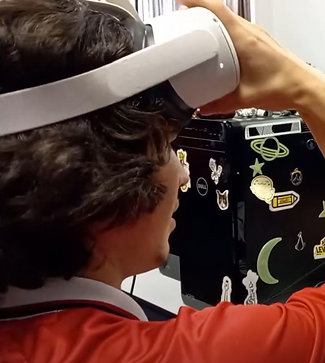
Once the final build was ready, it was launched in an open day to the general public to play.
Unfortunately, due to branding and copyright issues, I was never able to release the apk to itch.io or any other public domain, but I was fortunate enough to get good feedback during the presentation. The players seemed to admire the project greatly, especially all the football fans who would not have been able to have the experience in person otherwise.
Without a doubt, everyone rushed to the dressing room to experience the stadium walkout and hailed it as the best part of the tour!

Some Key Notes
-
In answering the initial question at hand during the idea conception, I concluded a couple of issues early on in production:
-
The first of these was attempting to make the tour available on mobile for increased accessibility was going to be difficult with the time given (Everyone has a mobile device so it will have to wait for future development)
-
The second is that it had to be optimised to the best standard as not everyone has the same equipment (That being said, the application ran incredibly well on the Meta Quest 2, around 70fps avergage)
-
Thirdly, way too much time was spent on the stadium in order to meet the vision goals (Over scope seems to be a running theme with game development)
-
Creating a software or game application as one person is a huge task to take on with a lot of time, energy, and effort spent
-
The biggest area for concern in doing this is that no collaboration skills are ever improved on which is ultimately one of the most important facets of design within the game industry
-
Final Thoughts
This was an absolutely incredible experience. I learned so much from tackling a new version of Games Technology and even from programs I have learned throughout the year such as Blender.
Virtual Reality is potentially the future in the way we interact with the world we are unable to gain access to and the metaverse has already started this trend.
Lighting was incredibly difficult to learn and master however, I really hope that in the future, I will be able to learn more about it as it costed time and resources for this project.
Thank you to Academy of Digital Arts for helping me realise the skills I was still to learn and making me understand that there is still a long way to go.
I hope you enjoyed the Virtual Stadium Tour of Anfield!
